
Social Listening for Lead Generation: The SaaS Founder's Playbook (2026)
TL;DR: Social listening generates 3-5x more qualified leads than cold outreach at 60% lower customer acquisition cost. Instead of blasting messages to strangers, you monitor platforms where buyers already describe the problem you solve — and respond at the exact moment of expressed need.
Key Facts
- 61% of organizations using social listening report increased revenue, according to Meltwater's State of Social Listening 2026 report — yet only 23% of SaaS companies use it for lead generation instead of brand monitoring.
- Social media monitoring tools detect buying signals 2-4 weeks before formal RFPs, per Gartner's B2B Buying Journey research, giving early-movers a critical first-responder advantage in competitive SaaS categories.
- Intent-based social listening produces leads at $200-$400 CAC compared to $800+ for paid search — a 60-75% cost reduction because you reach buyers who already identified their need.
- Reddit users are 3.2x more likely to research products than average social media users, according to Reddit's own research data, making it the highest-intent platform for B2B SaaS social listening.
- The first helpful response to a buying signal converts at 8-15%, compared to 1-3% for cold outreach — because timing and context replace volume and spray-and-pray.
Related: [Social Media as Marketing: The SaaS Founder](/blog/social-media-as-marketing-saas-2026) — covers Social Media as Marketing: The SaaS Founder\ from a different angle.
Why Social Listening Beats Traditional Lead Gen
Most SaaS founders generate leads the hard way: cold email lists, LinkedIn automation, paid ads. The numbers tell the story — cold outreach averages 1-3% reply rates, paid search costs $800+ per customer, and LinkedIn InMail has become nearly as ignored as cold email.
Social listening flips the model entirely. Instead of interrupting strangers, you find conversations where potential customers are already describing the problem you solve.
Right now, someone on Reddit is writing "Does anyone know a tool that does X?" — where X is exactly what your SaaS does. Someone on LinkedIn is posting about a workflow challenge your product fixes. Someone on Hacker News is complaining about your competitor.
These are warm leads with expressed intent. The only question is whether you're listening when they raise their hand.
Here's why social listening outperforms every other lead generation channel:
| Factor | Cold Outreach | Paid Ads | Social Listening |
|---|---|---|---|
| CAC | $600-$1,200 | $800+ | $200-$400 |
| Reply/Conversion rate | 1-3% | 2-5% click | 8-15% engagement |
| Timing | Random | Keyword-triggered | Moment of need |
| Buyer perception | Interruption | Advertisement | Helpful strangers |
| Compounding | None | None (stops when budget stops) | Authority builds over time |
The compounding effect is what makes social listening uniquely powerful for SaaS founders. Every reply builds your reputation. Every conversation teaches you about your market. Every helpful answer gets permanently indexed by Google. After 2-3 months of consistent engagement, the effort per lead decreases while the quality increases — the opposite of paid channels, where costs increase 10-15% annually.
This isn't theoretical. The same dynamic powers intent-based marketing across every channel — the difference with social listening is that the signals are public, real-time, and free to monitor.
The 5-Step Social Listening Framework for SaaS Leads
Step 1: Map Your Intent Keywords
Before you can listen, you need to know what to listen for. Most social listening setups fail because they monitor the wrong keywords — brand names or industry terms instead of buyer intent signals.
Build your keyword map in three tiers:
Tier 1 — Explicit Buying Intent (Highest Priority):
- "Does anyone know a tool that…"
- "Looking for a [your category] tool"
- "What's the best [your category] for…"
- "[Competitor name] alternative"
- "I'm switching from [competitor], what else is out there?"
Tier 2 — Implied Need (Medium Priority):
- "We've been struggling with [problem you solve]…"
- "How do you handle [workflow your product automates]?"
- "Frustrated with [pain point your SaaS addresses]"
- "[Competitor name] doesn't do X"
Tier 3 — General Awareness (Lower Priority):
- Industry trend discussions
- Best practice conversations
- Category-level debates
Aim for 20-30 keywords total. Source them from your actual customer conversations — support tickets, onboarding calls, G2 reviews of competitors, and Reddit threads in your niche. The exact words your customers use are more valuable than any keyword research tool.
Pro tip: Track which keywords generate actual conversations versus noise. After 2 weeks, you'll know which 8-10 phrases are your "golden signals" — the ones that consistently surface warm buyers.
Step 2: Select Your Monitoring Platforms
Not all platforms produce equal lead quality for SaaS. Pick 3-5 based on where your ICP actually discusses problems — not where they passively scroll.
| Platform | Lead Quality | Volume | Best For |
|---|---|---|---|
| 🔥 Highest | Medium | Technical SaaS, dev tools, SMB tools | |
| High | High | Enterprise SaaS, B2B services | |
| Hacker News | High | Low | Developer tools, technical products |
| Indie Hackers | High | Low | Micro-SaaS, solo founder tools |
| Twitter/X | Medium | Very High | Brand awareness, trending discussions |
| Quora | Medium | Medium | Information products, consulting tools |
| Facebook Groups | Medium | Medium | SMB tools, local/vertical SaaS |
| Dev.to / Stack Overflow | High | Low | Developer tools, APIs, infrastructure |
For most B2B SaaS founders, the highest-ROI starting stack is Reddit + LinkedIn + one niche platform specific to your vertical. Reddit produces the deepest conversations (paragraphs of intent context), LinkedIn produces the most volume, and a niche community (Indie Hackers, a specific Slack group, a Discord server) produces the highest-concentration signals.
The critical insight: conversation depth matters more than audience size. A Reddit thread where someone writes three paragraphs about their CRM frustration is worth 100 Twitter impressions.
Step 3: Set Up Your Monitoring Workflow
The difference between social listening that generates leads and social listening that wastes time is the monitoring workflow. Here's what works:
Daily routine (30-45 minutes):
| Time Block | Activity |
|---|---|
| 0-10 min | Scan new posts in 3-5 target subreddits/communities sorted by "New" |
| 10-25 min | Respond to 2-3 Tier 1/Tier 2 signals with value-first replies |
| 25-35 min | Check LinkedIn feed and HN for relevant discussions |
| 35-45 min | Follow up on yesterday's conversation threads |
The 2-hour response window: Speed is your competitive advantage. According to InsideSales.com research, the first responder to an inbound lead wins 35-50% of deals. The same principle applies to social listening — the first helpful reply to "Does anyone know a tool that…" is the one that gets upvoted, bookmarked, and acted on.
Sort by "New" on every platform. The goal isn't to find viral threads — it's to find fresh conversations before your competitors do.
What to track in a simple spreadsheet:
| Field | Why |
|---|---|
| Date | Detect patterns (e.g., Mondays = more tool-seeking posts) |
| Platform | Know where your best leads come from |
| Keyword triggered | Refine your keyword list over time |
| Intent tier (1/2/3) | Focus effort on highest-converting tiers |
| Responded? | Ensure no Tier 1 signal goes unanswered |
| Outcome | Track which responses generate profile clicks or DMs |
Step 4: Score and Prioritize Signals
Not every mention is a lead. Social listening at scale generates noise — you need a scoring framework to focus on signals that convert.
The Intent Scoring Matrix:
| Signal Type | Score | Example | Action |
|---|---|---|---|
| Direct tool request | 90-100 | "Looking for a [your category] tool" | Reply within 1 hour |
| Competitor complaint | 80-90 | "[Competitor] is too expensive/broken" | Reply with balanced comparison |
| Workflow problem | 60-80 | "How do you handle [problem you solve]?" | Share tactical framework |
| Industry discussion | 30-60 | "What's the future of [your category]?" | Contribute expertise |
| Passive mention | 10-30 | Someone mentions your category in passing | Monitor but don't engage |
The 80/20 rule applies: spend 80% of your engagement time on score 60+ signals. A single well-crafted reply to a "Looking for a tool that…" post converts at 10-15x the rate of engaging with a general industry thread.
For SaaS founders monitoring multiple platforms, signal scoring is where a social media monitoring tool pays for itself. Manual scanning across 5 platforms takes 2-3 hours daily. Automated intent scoring reduces that to 30 minutes by surfacing only the conversations that match your highest-converting patterns.
Step 5: Engage with Value-First Responses
The response is where social listening becomes lead generation. Get this wrong — by pitching too early or sounding generic — and you've wasted all the monitoring effort.
The value-first response framework:
- Acknowledge their specific situation — Reference details from their post to prove you actually read it
- Answer the actual question — Share a concrete tactic, framework, or experience that directly helps
- Include specific numbers — "We reduced churn by 34% by switching from monthly to usage-based billing" is 10x more credible than "Usage-based billing works better"
- Optional: mention a relevant resource — A blog post, guide, or comparison that adds value (not a product page)
- End with a question — Drive deeper engagement and learn more about their needs
What NOT to do:
- ❌ Pitch your product in the first reply
- ❌ Copy-paste the same response across threads
- ❌ Sound like a marketer (formal language, "leverage," "synergize")
- ❌ Drop links without context
- ❌ Reply to threads older than 48 hours (most platforms de-prioritize late responses)
The product discovery happens through your profile, not your pitch. After you've provided genuine value, curious prospects click your profile → read your bio → visit your site. This is how social selling consistently outperforms cold outreach — the buyer discovers you on their own terms.
Social Listening Tools Compared — What Actually Works
The social media monitoring tool market is crowded, but most tools are designed for brand monitoring (tracking mentions of your company name) — not lead generation (tracking buyer intent signals). Here's how the categories differ:
Related: How to Find Buyer Intent on Social Media in 2026 — covers How to Find Buyer Intent on Social Media in 2026 from a different angle.
Brand Monitoring Tools (Not Built for Leads)
Tools like Brand24, Mention, and Hootsuite excel at tracking brand mentions, sentiment analysis, and PR monitoring. They'll tell you when someone mentions your company. But they won't tell you when someone is looking for a product like yours without mentioning you by name.
For lead generation, brand monitoring has a fundamental blind spot: your best leads don't know you exist yet. They're describing a problem, not searching for your brand. The comparison between Brand24 and Hootsuite shows both are optimized for enterprise brand health, not SaaS lead discovery.
Enterprise Social Intelligence (Overkill for Startups)
Sprout Social, Brandwatch, and Talkwalker offer advanced analytics, competitive intelligence, and team collaboration. Starting at $300-$1,000+/month, they're built for marketing teams at established companies — not solo founders or small SaaS teams.
Intent-Based Social Listening (Built for Leads)
A newer category of tools focuses specifically on finding purchase intent signals across social platforms. These tools monitor pain phrases (not just brand mentions), score conversations by buying intent, and surface actionable leads — not just analytics dashboards.
The full comparison across social listening tools shows the key differentiator: does the tool find people who need your product, or just people who mention your product? For lead generation, you need the former.
How to Automate It
The bottleneck in social listening for lead generation is coverage. Manually scanning 5-15 platforms for 20+ pain phrases takes 2-3 hours daily — unsustainable for any founder who also needs to build product.
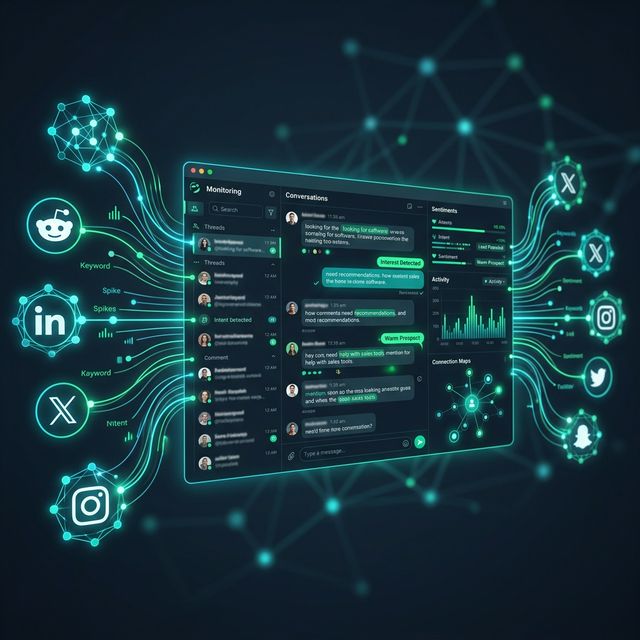
Tools like Prems AI automate the monitoring and scoring layers: they track your intent keywords across 9+ platforms 24/7, score every conversation for buying signals, and surface only the highest-priority leads. You still do the engaging — that's what makes it authentic — but the discovery is automated.
Key Takeaways
- Social listening is the highest-ROI lead generation channel for SaaS — $200-$400 CAC vs $800+ for paid search, with 3-5x higher conversion rates because you reach buyers at moment of expressed need.
- Monitor intent signals, not brand mentions — Your best leads don't know you exist yet. Track the pain phrases and buying signals that indicate someone needs your product, not your company name.
- Score every signal by intent tier — Not every mention is a lead. Spend 80% of engagement time on Tier 1 (explicit buying intent) and Tier 2 (implied need) signals. Ignore Tier 3 noise.
- Speed wins deals — Reply to buying signals within 2 hours. First responders win 35-50% of deals. Sort by "New" on every platform to catch fresh conversations.
- Value-first responses convert 8-15% — Share genuine tactical advice, not product pitches. Product discovery happens through your profile after you've proven expertise in the thread.
- Compounding makes social listening cheaper over time — Unlike paid ads, every helpful response builds permanent authority. After 2-3 months, inbound leads from community reputation reduce the active monitoring effort required.
Related: Best LinkedIn Lead Generation Tool for 2026 — Stop Cold Messaging — covers Best LinkedIn Lead Generation Tool for 2026 — Stop Cold Messaging from a different angle.
Find warm leads while you read
Prems AI scans 10+ platforms for buyer intent — so you don't have to.
What Prems AI Does For You:
- 24/7 Monitoring — Scans 10+ platforms while you sleep
- AI Intent Scoring — Every post scored 0-100 for buyer readiness
- Instant Alerts — Get notified when hot leads appear
- AI Pitch Generation — Personalized reply drafts in seconds
Continue Reading
Stop searching. Start closing.
Prems AI finds high-intent buyers on Reddit, LinkedIn, and 8 other platforms — scored 0-100 for buyer readiness.
Get my leadsTell us who you want to reach. We run the search and send the report.